By Kennedy Maize
While President Trump’s quixotic efforts to reverse the decline on what he calls his “beautiful clean coal” has failed, a pernicious aspect of that industry has increased: black lung.
Last month, the American Journal of Respiratory and Critical Care Medicine published a new study from the National Institute for Occupational Safety and Health (NIOSH) examining the prevalence of the clinical disease of “coal workers’ pneumoconiosis,” colloquially known as black lung, in underground miners in central Appalachia from 1974-2025. They found that it has recently increase dramatically, despite decades of largely successful efforts to control the variant of the well-known occupational disease silicosis. 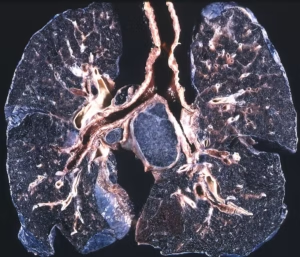
NIOSH is part of the Centers for Disease Control and Prevention, an agency of the U.S. Department of Health and Human Services. NIOSH runs the “Coal Workers’ Health Surveillance Program (CWHSP,)” which monitors miners health in five-year periods, starting in 1974.
Congress in 1969 established the Federal Coal Mine Health and Safety Act, aimed at protecting underground coal miners from black lung. In 1977, Congress passed the Federal Mine Safety and Health Act, administered by the U.S. Department of Labor. That law gave the federal government authority to set dust control standards in the nation’s underground mines. Labor also manages a compensation program for miners injured by black lung through the Mine Safety and Health Administration.
According to the NIOSH paper, “In 1974, the first round of x-ray surveillance under the CWHSP documented a 32.5% prevalence of CWP among miners with 25 or more years of mining experience (using a 5-year moving average).” The 1977 law had a positive effect, according to NIOSH: “By 2000, the prevalence of CWP among working underground coal miners in the United States was below 5% across all tenure groups.”
Since then, things have turned sour: “Since 2000, the national prevalence of CWP among underground coal miners has increased across all work tenure categories of ten or more years.” The increase in black lung disease has been concentrated in Kentucky, West Virginia, and Virginia, the traditionally dominant region for underground coal production.
The greatest increase in black lung diagnoses has come recently. According to the NIOSH study, “Taken together, the convergence of findings across surveillance, clinical, and administrative data systems supports the conclusion that the current burden of disease reflects not only a sustained and ongoing problem but a notably sharper increase in CWP prevalence in central Appalachian miners in the post-COVID era.”
In that principal coal region, it’s 1974 again. In the most recent survey, 33% tested positive by NIOSH-conducted X-rays during the past five years.
The government researchers do not point to any causes for the increase, but outside groups that follow the issue do.
An important part of the increase is geology. Black lung disease is primarily a result of exposure to silica in the coal dust. The NIOSH paper notes, “Substantial evidence indicates that exposure to the respirable crystalline silica component of coal mine dust plays an important role in contemporary disease patterns, particularly in central Appalachia.”
Public Health Watch, reporting on the NIOSH study, observes, “In recent decades, the biggest coal seams in Appalachia were mined out. Mining companies turned to the thinner seams that remained, digging through mountains to reach and then mine them. That requires cutting lots of rock, and in Appalachia that rock typically contains quartz, which is rich in silica. The result is clouds of both coal dust and highly toxic silica dust.”
Another component of the increase in black lung disease is government policy. In March 2025, with Elon Musk’s misnamed “Department of Government Efficiency” slashing federal agencies and programs indiscriminately, Labor ordered 34 MSHA offices in 19 states handling black lung cases closed.
At Health and Human Services, Secretary Robert F. “Make America Healthy Again” Kennedy laid off 873 NIOSH workers. He also proposed shifting NIOSH from the Centers for Disease Control and Prevention and into a new Administration for a Healthy America, which has not occurred.
At the same time, MSHA put on hold a long promised new rule on controlling silica exposure in coal mines, blaming the proposed NIOSH reorganization. It has never reappeared.
KFF Health News wrote this month, “In April of last year, the Trump administration paused the enforcement of a rule designed to help protect coal miners from an aggressive form of coal workers’ pneumoconiosis, commonly known as black lung disease, the primary cause of which is exposure to silica dust…. This April, the Labor Department’s Mine Safety and Health Administration announced an indefinite delay in enforcement of the rule.” eal
The administration’s indifference to black lung has sparked political backlash in the region. Andy Beshear, Kentucky’s Democratic governor (in a red state) last week (Sept. 24) sent a letter to the Bluegrass State’s congressional delegation (two Republican Senators, five Republicans and one Democrat in the House) calling for legislation expanding black lung benefits. He said the “Support Our Miners Act (H.R. 9556) would increase black lung benefits to match inflation for the first time.” Beshear wrote, “Our Appalachian region is currently facing a resurgence of black lung disease, with 20% of veteran coal miners — one in five — suffering from this incurable respiratory condition. Now more than ever, miners need to receive the support they were promised, and this legislation is a Step toward that goal.”
Beshear, a skillful pragmatist, is getting some attention as a possible Democratic nominee for President in 2028.
The Quad Report, covering energy policy and politics

