By Kennedy Maize
One of the largest proposed data center developments in the U.S. — Project Jupiter, named after the largest planet in the solar system — is causing some turmoil in New Mexico, including a ruling by the state’s high court halting review of an air quality permit for the project in Doña Ana County on the Mexican border. The county is the second most populated in the Land of Enchantment, with Las Cruces the county seat (population 118,112).
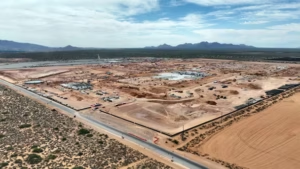
Some local residents have protested the siting of the data center, citing air quality and water consumption as reasons to oppose the project. A spokesman for Gov. Michelle Lujan Grishham has said she “takes seriously the concerns Doña Ana County residents have raised about Project Jupiter — including on air quality and groundwater use — and expects any data center operating in New Mexico to meet the state’s rigorous environmental standards and use water responsibly.”
A partnership of Oracle and Open AI, Project Jupiter is a data center campus, with four possible centers. The first, with on-site generation, is a 2.45-GW project powered by Bloom Energy fuel cells, a change from the original plan to use diesels and gas combustion turbines. Oracle says the change will reduce water use, a key issue, and eliminate most air emissions of oxides of nitrogen, as fuel cells do not generate electricity by burning fuel. Using methane, they produce CO2 and trace amounts of NOx.
The state court ruling on Aug. 23 delayed an air quality hearing set for Sept. 14 and ordered the Office of the State Engineer to put a hold on a permit allowing water from a specific local well to be used for the data center’s construction. Construction on the project continues. Oracle says it hopes to have the project in service in the first half of next year.
Opposition to the project last fall focused on the use of gas-fired combustion turbines. Oracle in April announced that they were switching to fuel cells. In a news release, Oracle said, “This updated power design will replace Project Jupiter’s previously planned gas turbines and diesel generators and consolidate the facility into one single microgrid campus.
“Fuel cells generate electricity without combustion, meaning the Bloom microgrid is highly efficient with low emissions and water use. Compared to its previously planned gas turbines, Project Jupiter with the Bloom microgrid will reduce NOₓ emissions by approximately 92% and will use a negligible amount of water.”
The fuel cells will still use natural gas in their electrochemical process, but not in the quantities needed for combustion, around 15-25% less gas than combustion turbines of the same electric output. Project Jupiter will also use closed-cycle cooling, reducing water needed to cool the banks of computers processing the flood of data that flows in and out of the centers.
A gas pipeline issue is also on the table. Source NM news service reported, “In a petition to the state Supreme Court, the Santa Fe-based clean energy group New Energy Economy argued that such a hearing could be premature because the pipeline intended to feed the fuel cell system has not yet gained the necessary approval to be built. In fact, New Mexico Commissioner of Public Lands Stephanie Garcia Richard has twice shot down its developers request to build a portion of it on state trust land, and recent federal regulatory filings show it may not come online until early next year.”
The local concerns about the project have drawn the attention of the region’s representative in Congress. Democratic Rep. Melanie Stansbury raised water consumption issues with the state engineer, who mostly found no problems with the purchase of an existing water right to supply water used during construction.
State Engineer Elizabeth Anderson responded that last October, the owner of the water right filed an application for “an emergency replacement well” and a state engineer “visited the well site, confirmed that the well was in use but was suffering from casing failure, authorized drilling the replacement well and directed the owner to publish notice of the application pursuant to OSE’s standard notice procedures.” The notice produced “more than 30 protests.”
That prompted Stansbury to post on Bluesky last Wednesday that the protests “have not yet been adjudicated,” and “no formal hearings appear to have been held regarding these protests,” and “no other water permits have been filed to address the long-term operational needs of the project, and no clear and consistent information has been provided to the public regarding water use of the project post-construction.”
Stansbury called on the state to “conduct a thorough review and adjudication of the project’s current and proposed water use before further proceeding — including consultation with New Mexico’s Tribal Nation, acequias, and senior water users.”

Acequias are community-operated irrigation canals found in Colorado and New Mexico. According to Wikipedia, “Acequias are filled by snow melt and rain to water orchards, gardens, and other agricultural fields. Other than watering crops, acequias have deep cultural significance for many Indigenous and Native communities in New Mexico and Colorado.”
The Quad Report, covering energy policy and politics