By Kennedy Maize
The Trump administration is pondering resurrecting a nuclear power application 54 years after an earlier, quite similar, attempt cratered. The Department of Transportation’s Maritime Administration (MARAD) earlier this month (May 7) issued a “request for information” launching what Transportation Secretary Sean Duffy described as “an initiative to develop Small Modular Nuclear Reactors (SMR) for commercial shipping.”
Duffy said the intent of the information request is for “innovators and industry stakeholders to help develop an SMR model that revitalizes U.S. shipbuilding, cuts costs, and secures energy dominance.” MARAD Administrator Stephen M. Carmel said, “We are seeking critical insights on how the government can help reduce systemic uncertainty, align regulatory structures, and enable the market conditions necessary for private capital and operators to scale these groundbreaking technologies.”
The Federal Register notice is less hyperbolic in describing the information MARAD is seeking, saying it is “for a single vessel or technology demonstration…on proficient system architecture, including liability frameworks, insurance pathways, port acceptance, workforce development, and standards integration for vessel deployment.”
The only serious U.S. attempt to leverage its experience with Navy nuclear propulsion into the civilian sector lasted only 10 years, from 1962 to1972. It was the NS Savannah, with the “NS” standing for “Nuclear Ship,” in contrast to the conventional denominator “SS” for “Screw Ship.” The SS Savannah in 1819 was the first steam-powered ship to cross the Atlantic (although it was mostly done on sail and was an economic failure).

In 1955 as part of his “Atoms for Peace” program, President Dwight Eisenhower called on Congress to authorize a civilian nuclear-powered merchant ship. Congress initially rejected Ike’s call for $21 million to build and support such a vessel. With the White House pushing the project, Congress soon complied, authorizing MARAD (then part of the Commerce Department, before the creation of the Department of Transportation in 1967) to undertake the project.
New York Shipbuilding Corp. of Camden, N.J. laid down the keel in 1957. Babcock & Wilcox, experienced with Navy nuclear reactors, supplied the 74-MW pressurized water reactor based on the Navy’s Nautilus nuclear submarine. A key difference: Savannah’s reactor used low-enriched fuel. The reactor supplied steam for two steam turbines driving a single propeller shaft. The ship eventually cost $47 million, $19 million for the ship itself and $28 million for the reactor and nuclear fuel.
The 596-foot Savannah was designed for both cargo and passenger service. It had nine watertight compartments housing seven cargo holds plus space for the reactor and other machinery. Three decks rose above the holds. The topmost was the pilot house and related services along with an emergency diesel generator. Below that was officer housing and a bar, lounge, and a dance floor shared with the passengers.
“A” deck was the main entry point, containing the lobby, an infirmary, beautician, and 30 luxurious staterooms with private bath and accommodations. This deck also included a health physics lab to monitor effects of the reactor.
First Lady Mamie Eisenhower christened the ship with the traditional bottle of champagne smashed across the bow on July 21,1959, two years after Russia launched the Lenin ice breaker, the world’s first nuclear powered civilian vessel. Savannah’s 1962 maiden voyage was an around-the-world flag-waving cruise.
A lengthy Wikipedia article summarizes NS Savannah’s history at sea: “During her active career, Savannah traveled 450,000 nautical miles (830,000 km), visiting 45 foreign and 32 domestic ports and was visited by 1.4 million people in her function as an Atoms for Peace project. Savannah‘s presence also eased access for nuclear-powered naval ships in foreign ports, though the ship was excluded from ports in Australia, New Zealand and Japan.”
MARAD stopped money-losing passenger service in 1965. The ship’s limited cargo space was also an economic drag.
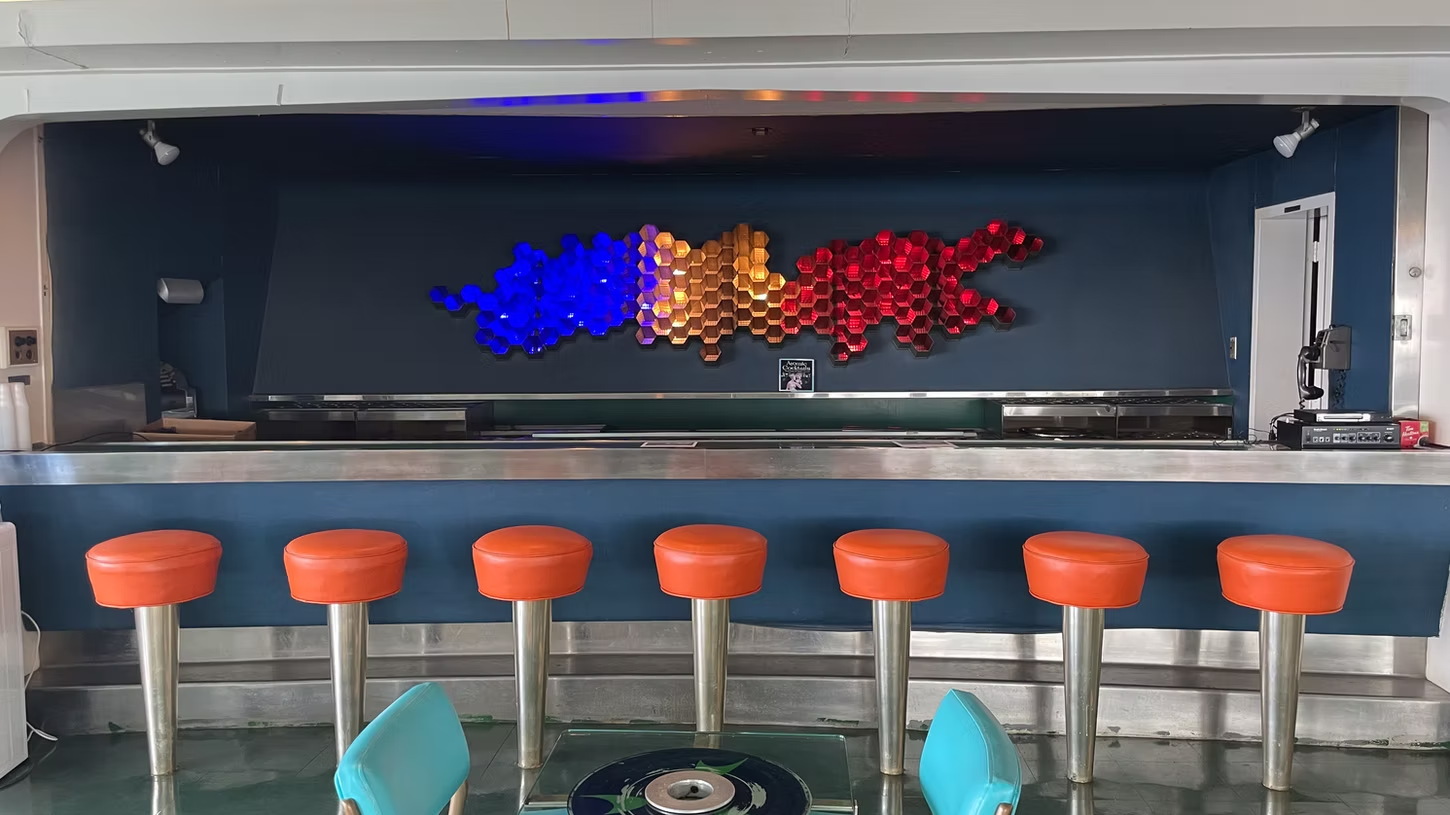
The ship also experienced some labor problems over a pay differential between deck officers and nuclear engineering officers. MARAD took the ship out of service at the end of 1971. The reactor fuel was removed in 1975. The reactor was 86-ed and moved to Utah in 2022.
The reactor and propulsion systems worked well together. The nation’s only civilian nuclear ship was a technological success and an economic failure. That was programmed into the project from that start, as it was neither cargo ship fish nor passenger ship fowl.
Eisenhower hoped it would demonstrate economic advantages. When announcing the project in 1956, Eisenhower said, “Atomic merchant ships will be able to operate on longer runs at higher sustained speeds. They will be able to carry more cargo on long voyages than conventional ships because of the saving in fuel space. They will need less time in port, since they will operate for long periods without refueling.”
NS Savannah is currently docked in Baltimore, where it has been since 2008, under MARAD supervision and undergoing complete decommissioning under Nuclear Regulatory Commission supervision. That project is expected to be completed this year. The ship is on the list of National Historic Landmarks and is a tourist attraction hosted by the N.S. Savannah Association, which offers tours. The association is reaching out for help, proclaiming, “The NS Savannah is expected to relocate before the end of the year, but her future remains uncertain. While proposals, including one from Savannah, are under review, no outcome is guaranteed.”
It isn’t clear who, if anybody, in the administration is pushing nuclear ships other than Duffy. A recent article in Global Trade magazine noted, “Multiple federal agencies are participating in the effort, including the U.S. Coast Guard, the Nuclear Regulatory Commission, and the Department of Energy, as regulators begin addressing the legal, operational, and safety challenges associated with civilian nuclear-powered vessels.”