By Kennedy Maize
For 80 years, the U.S. government and its industrial and utility partners have failed to, first, understand the problem of the noxious and dangerous waste produced by the pursuit of nuclear power for war and peace and, second, to successfully respond.
HANFORD It begins, as does much of the story of nuclear energy, with the U.S. response to World War II: the Manhattan Project. The project’s pioneers paid little attention to what was left behind when they stripped U-235 from U-238 or made plutonium from uranium. Understandable at the time, it was shortsighted.
When they thought about waste at all, the nuclear engineers saw it as a simple problem they could deal with later, much later. They poured the nasty brew of chemical and nuclear poisons into large, oil-field-derived stainless steel tanks.

In 1947, pioneering Baltimore “sanitary engineer” Abel Wolman — who had standardized the use of chlorine to purify drinking water — joined the Atomic Energy Commission’s advisory board. Troubled by the accumulation of the wastes, Wolman and a colleague examined the site.
In 1948, Wolman warned the AEC that the wastes were dangerous and poorly managed. His report was largely ignored. By early 1953, Hanford was generating nine million gallons of liquid waste daily. AEC engineers assured management that the storage tanks could not leak.
The tanks began leaking in the 1960s, setting off a continuing cleanup program. According to a March 2025 DOE report, the department has spent $66 billions of taxpayer money on the Hanford cleanup so far, with another $589 billion required to finish the job.
LYONS, KANSAS Enthusiasm for civilian use of nuclear energy kicked off with President Eisenhower’s 1953 “Atoms for Peace” speech at the United Nations. In 1955, AEC Chairman Glenn Seaborg warned that disposing of the “tremendous quantity” of waste that would result could be a limiting factor for widespread use of nuclear power plants.
The next year, a National Academy committee that Wolman chaired said several approaches to disposing of the wastes were possible but should be identified. In 1957, the academy said the best choice to dispose of the highly radioactive wastes was burying them in underground salt formations.
That recommendation set off a more than decade-long search for a suitable site. The AEC in 1970 settled on salt beds near Lyons in central Kansas. Typically, the AEC officials had not taken care that the local public supported the project. The Lyons site selection set off a political backlash.

The local congressman, Republican Rep. Joe Skubitz, launched a political blitzkrieg against the AEC. They helped Skubitz in 1971 with an inadequate environmental impact statement, then arguing that the 1969 National Environmental Policy Act didn’t really apply to them.
Disposing of nuclear waste in Kansas became impossible. In May 1971, an official of a firm mining the salt told the AEC that the beds were riddled by oil and gas wells drilled there over the years, providing multiple pathways for corrosive water to reach the nuclear waste.
NWPA By the mid-1970s, the civilian nuclear power industry was in trouble. Plants were very expensive, political opposition arose, the new plant pipeline of emptied. Congress gutted the AEC, creating the U.S. Nuclear Regulatory Commission and, in 1977, the Department of Energy.
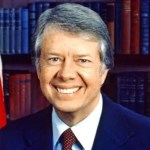
The problem of what to do with the ever-increasing volume of spent nuclear fuel became a DOE problem. President Jimmy Carter (a nuclear engineer) and Jim Schlesinger, Carter’s energy secretary and former Republican AEC chairman, brainstormed with others in the new administration and came up with an idea for “away from reactor storage.”
Uncle Sam would take title to utility spent nuclear fuel. DOE would store the fuel rods at a temporary site while the feds develop a permanent, underground graveyard. During 1980, Carter’s last year in office, the House and Senate passed separate nuke waste bills but were unable to reconcile their differences before Congress expired.
Work began again in 1981, with Republican Ronald Reagan in the White House. The GOP held the Senate. Democrats owned the House. Congress again took up nuclear waste, with little interest from 1600 Pennsylvania Ave. In 1982, Congress passed the Nuclear Waste Policy Act, providing for away from reactor storage and a nationwide search for an acceptable final, underground, but unidentified permanent storage site.
The new law proved wildly unpopular as DOE began investigating various possible locations for a final waste dump. Local ire was fierce and bipartisan. The first Reagan administration came to an end with no site in sight. The DOE workers reviewing possible sites thought the job was technical. It was far more than that. The politics became so intense that Reagan’s third DOE secretary, Californian John Herrington, concerned about the upcoming 1986 off-year elections, pulled the plug on the siting process in May 1986. The Nuclear Waste Policy Act died unlamented.
SCREW NEVADA As Herrington feared, the fall elections saw a Republican thrashing. Democrats controlled the Senate by a 55-45 margin. The House became more solidly Democratic.
Nuclear waste was back on the political agenda, with a twist. One of the sites that DOE had examined during the short life of the NWPA was a mountain on vast federal land in Nevada, named Yucca Mountain. It looked promising: remote, dry, no nearby volcanic activity, far away from residents and voters.

Picking up on an idea promoted by Science Magazine journalist Luther Carter, Sen. J. Bennett Johnston, Louisiana Democrat and chairman of the Senate Energy and Natural Resources Committee, and his Idaho Republican colleague, Sen. James McClure, launched language ordering DOE to stop looking elsewhere and focus on Yucca Mountain. They attached their provision to an omnibus 1987 government appropriations bill. It became law without debate in any committee or on the House or Senate floor. It instantly became the “Screw Nevada Act.”
YUCCA MOUNTAIN The story ends here. Yucca Mountain became a technical and political dead end. Among other problems, the enormous tunnel DOE dug into the mountain showed it wasn’t dry. In 2002, physicist and nuclear expert Victor Gilinsky told a congressional committee of his site visit. He testified, “I was pretty surprised therefore to find myself in the middle of this mountain with water dripping out of it and hitting me on the head.”
The Obama administration in 2009 opposed going with Yucca Mountain, urged on by now Senate Majority Leader Harry Reid (D-Nevada). Industry interests tried to revive it over the years, including in the first Trump administration. In 2020, the Trump White House abandoned Yucca Mountain.
The Quad Report, covering energy policy and politics

