By Kennedy Maize
The federal government-owned Tennessee Valley Authority, the nation’s largest publicly owned electric generation and transmission enterprise, has been releasing a flurry of announcements about deals to put new, smaller nuclear plants on its generating menu.
The deals involve potentially multi-billions of dollars in investments. The announcements include action by the U.S. Nuclear Regulatory Commission granting TVA a construction license for a new, multi-unit nuclear station on an old Clinch River site. It was once the site of the failed 1980’s Clinch River Breeder Reactor.
Are the TVA’s announced plans real or are they aspirational? The jury is out on that question.
The problem with the announcements is that none of them appear to have seen money change hands between TVA and the nuclear vendors. TVA describes them as “conditional agreements.”
The most recent is the Clinch River announcement. TVA described “a nationally significant milestone in America’s nuclear energy future with the U.S. Nuclear Regulatory Commission’s (NRC) issuance of the construction permit for Clinch River Unit 1, a GE Vernova Hitachi Nuclear Energy BWRX‑300 small modular reactor (SMR), at TVA’s Clinch River Nuclear Site near Oak Ridge, Tenn.”
Wow! Despite nearly a decade of hype in America about SMRs, will this be the first in reality? Not quite. The next paragraph in the TVA news release unveils a bit of the truth plus an outright lie: “While no construction date has been announced, TVA is now the first U.S. utility permitted to construct the BWRX‑300 SMR. This is only the second advanced reactor construction permit ever issued in the nation.” 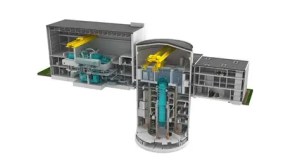
First, no construction date, which is true. In part, that’s because the NRC has given TVA a green light only to begin construction. The construction permit is in advance of an approved reactor design.
The regulators have not given the 300-MW boiling water reactor a license, although it is closely related to earlier, much larger GE reactors. GE submitted its BWRX-300 reactor design to the NRC in 2019.
Also, in its news release on the TVA construction license, the NRC said, “TVA will need a separate operating license from the NRC. TVA previously received an early site permit for the Clinch River site in 2019.” TVA is considering possibly four BWRX machines at Clinch River and others at the Bellefonte site of an abandoned, uncompleted conventional large reactor.
Terra Power’s unlicensed Natrium sodium cooled, 345-MW reactor planned for Kemmerer, Wyo., earlier won a construction green light for the non-nuclear portions of the plant. Under the current nuclear typology, a 300-MW machine classifies as a “SMR,” while a 345-MW reactor is not.
TVA’s deal with GE Hitachi is the second announced with a fanfare for small modular reactors. Over a year ago, TVA announced an ambitious but amorphous non-binding deal with Entra1 Energy, the business end of a partnership with pioneer SMR developer NuScale Power (NYSE:SMR).
The relationships between ENTRA1, NuScale, and TVA are unusual. TVA and ENTRA1 describe it as a “collaboration.” In their joint news release describing the arrangement, “ENTRA1 Energy will collaborate with TVA to develop plants to provide TVA with up to 6 gigawatts of new nuclear power generation on sites in TVA’s seven-state region through the deployment of six ENTRA1 Energy Plants.”
NuScale is almost an afterthought in the news release. The plants were designed by Oregon-based NuScale, which holds an NRC generic design license, the only small modular reactor to have achieved that important step. The company gets mentioned only in the context of the hyped “collaboration.”
Under the hypothetical deal, TVA will sign a power purchase agreement with ENTRA1, with the funds coming from TVA’s retail sales over its seven-state region.
The financial entanglements between TVA and ENTRA1 are unclear. Publicly-traded NuScale and ENTRA1, a private LLC, have a formal “Partnership Milestones Agreement” on file with the U.S. Securities and Exchange Commission. Under the agreement, “ENTRA1 is NuScale’s exclusive global strategic partner and holds exclusive rights for the worldwide commercialization, distribution, sales and development of NuScale’s products and services.”
ENTRA1 has a convoluted history. Originally formed and based it London, it is now headquartered in Houston. It is led by a secretive American-Middle Eastern family with multiple businesses focused on energy development, close ties to Fluor Corp., formerly NuScale’s largest shareholder; direct ties to the Trump administration; and no hands-on experience with nuclear power construction or operation.
NuScale’s stock has been getting hammered for months, with a lot of short selling activity driving it down. Its deal with ENTRA1 is one of the reasons. The Motley Fool investment web site reported at the end of August that the TVA arrangement could lead to “about 72 of the company’s 77-megawatt modules — the largest deployment of its kind in U.S. history if it converts.” Motley Fool analyst Daniel Sparks noted, “But the agreement behind that program was signed by TVA and ENTRA1 Energy, NuScale’s exclusive commercialization partner. NuScale wasn’t a party to it.”
Sparks said, “So NuScale’s role, if the program converts, is that of a supplier — selling modules into plants someone else owns, while that someone else collects the power revenue.”
So far, Sparks said, NuScale has insignificant revenue, while its market value is around $4 billion. He added, “NuScale has recorded a $507.4 million expense for the first milestone payment it made to ENTRA1, and a binding power purchase agreement would trigger a second, larger one.
“NuScale’s agreement caps the sale price of each module and gives ENTRA1 sole discretion over whether to buy from NuScale at all.”