By Kennedy Maize
A controversial Consumers Energy deal to sell 13 small, old hydropower plants to a Maryland firm on an installment plan is drawing fire at the Michigan Public Service Commission. At a March 23 MPSC hearing, what would amount to a $160 million transaction faced skepticism from the commission staff, environmental and sport fishing interests, consumer advocates, and the Michigan Department of Natural Resources (DNR).
The DNR’s participation in the case is unusual. According to the Detroit News, “It’s the first time the department has gotten involved in a case before Michigan’s energy regulators, who will rule on the sale, DNR Director Scott Bowen said, ‘a rare thing for us.’”
The dams — built along five Michigan rivers between 1906 and 1935 — total 132 MW of generating capacity. One of the projects — the 9-MW Croton Dam on the Muskegon River — is listed on the National Register of Historic Places.
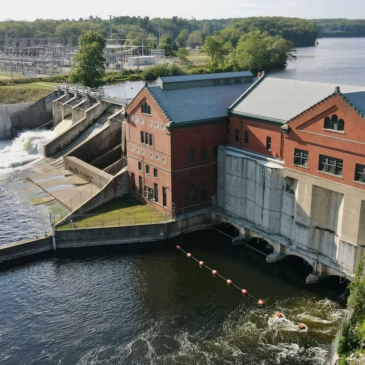
Under the deal Jackson-based Consumers announced in September it would sell the dams to Confluence Hydro, a subsidiary of Maryland-based Hull Street Energy, a private equity firm. The utility faces potentially expensive repairs and upgrades to the earthen dams, and potentially lengthy future relicensing proceedings at the Federal Energy Regulatory Commission.
Consumers has threatened to demolish the dams if the sale does not go through.
At the hearing, MLive reported, “A key witness for Consumers Energy acknowledged under cross-examination this week that the utility’s estimates for dismantling its hydroelectric dams rely on limited site data and assumptions provided by a consultant.
“Consumers engineering director Richard Blumenstock said the utility does not know how much sediment or contamination is present behind its dams and the consulting firm that developed decommissioning estimates, WSP, did so without site-specific sediment data.”
Driving the sale, the utility faces potentially hundreds of millions of dollars in repairs to its 95-year-old, 31-MW Hardy Dam on the Muskegon River. When commissioned in 1931, it was the largest earth-filled embankment dam in the U.S. In a March 16 filing, the company asked the Federal Energy Regulatory Commission for permission to put off a long-planned $350 million replacement of Hardy’s spillway.
Under a 2024 FERC order, Consumers must begin work on Hardy Dam in May. In the petition to FERC, the utility says a “two-year delay allows time for review and approval of the proposed sale and time for the new licensee to coordinate construction activities.”
The 13 dams on the sale list are up for FERC license renewals between June 2034 and May 2041. The utility says. “As the relicensing process – which can take up to seven years to complete – approached, Consumers Energy began evaluating the future of the Facilities. The aging plants require significant capital investments in order to maintain their FERC operating licenses.”
Local CBS News reported, “Averaging more than a century old, the dams generate $12.9 million-worth of power annually and face hundreds of millions of dollars in maintenance and repair costs. State utility regulators have hesitated to let Consumers charge those costs to ratepayers who derive little benefit.”
In the deal, Hull Street would pay Consumers $1/dam and then would sell Consumers the power from the dams under a 30-year power purchase agreement. The utility would pay Confluence $160/MWh with an annual 2.5% escalation. Critics claim the deal is above the market price. The deal also includes an “Environmental Indemnity Agreement,” which Consumers says “is necessary to effectuate Confluence’s assumption of the environmental liabilities associated with the Facilities.”
At the MPSC hearing, Jessica Mistak of DNR’s fisheries division told the energy regulators that “Confluence Hydro, LLC is new hydropower project owner with an unproven track record that would not be subject to Michigan Public Service Commission oversight to recover reasonable costs; instead, my understanding is they could operate to maximize revenue and minimize costs, including costs associated with maintaining FERC license compliance.” She said she has “witnessed problems with hydropower project owners who use complicated structuring of LLCs to limit liability and declare bankruptcy for single assets, all while ignoring FERC regulatory requirements.”
Chicago-based Environmental Law & Policy Center — with offices in nine Midwestern states and the District of Columbia — is representing five Michigan conservation groups, including sport fishing groups. ELPC attorney Daniel Abrams says, “Hull Street proposes to create 13 separate LLCs, one for each dam.
“Under this structure, Hull Street could bankrupt, abandon, or sell them off individually. If the Commission approves the sale of the dams, it no longer has jurisdiction over future action. What if big developments pop up along the adjacent riverfront land, limiting public access for hiking, fishing, and other popular recreation?”
MPSC staff has also been concerned about the sell-off potential of the deal since it was announced in February. According to MPSC engineer Jonathan DeCooman, “Staff did not find any terms or conditions which would limit the ability of Confluence to transfer ownership of all or part of the hydro fleet to an unaffiliated third party.” The staff testimony also found that the contract does not require that Confluence operate the dam for the full 30-years of the deal.
Should Hull Street and Confluence succeed at the Michigan commission, they will also face a trip to Washington and the Federal Energy Regulatory Commission, which will have to approve the transfer of the licenses, and where the future of the dams may again arise.